Introduction
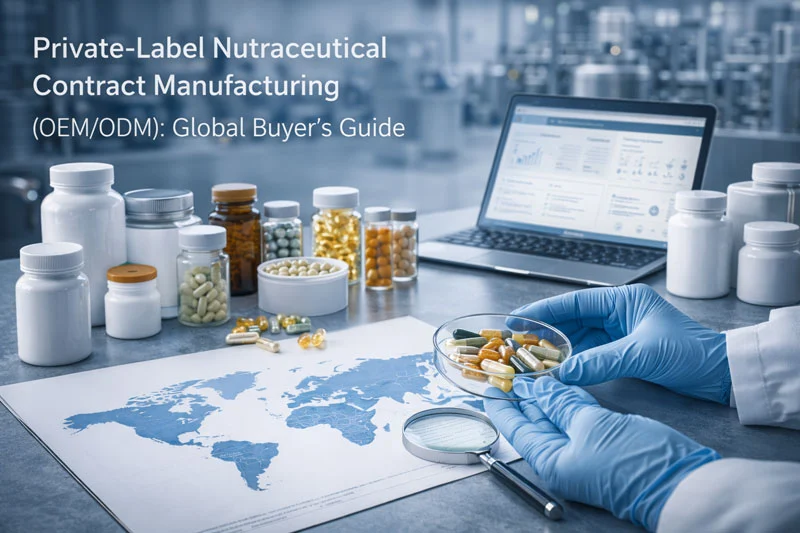
The private label (OEM/ODM) model for nutraceutical manufacturing allows companies to quickly introduce their brand products to the marketplace at a lower cost and with greater production capabilities without needing their own manufacturing facilities. This guide is intended for prospective buyers seeking qualified manufacturers with the intent to request quotes as part of the sourcing process. (Also Read: Top Nutraceutical & Dietary Supplement Manufacturers in Asia in 2026)
What is private-label nutraceutical contract manufacturing?
A private label (OEM/ODM) nutraceutical manufacturer creates final products such as tablets, capsules, gummies, and powdered supplements that can be sold under your brand name.
- OEM: The buyer provides a formulated product and the manufacturer creates and packages it.
- ODM: The manufacturer creates and packages a product that has been developed based on the buyer's specifications.
Services usually provided by contract manufacturers include R&D for new formulas, small batch production for testing purposes, scaling up production volume for larger runs, analyzing samples and providing certificates of analysis (COAs), packaging and labeling finished supplements, preparing the proper documentation to export products, and more.
Advantages of using a private-label manufacturer
- Speed to market: Product launches can occur in weeks rather than years.
- Reduced capex: No need to invest in building a facility, there are lower costs associated with starting up.
- Flexibility: Private-label manufacturers offer brands the ability to test different SKUs (stock keeping units), flavors, forms, and minimum order quantities (MOQs).
- Compliance leverage: By using the GMP (good manufacturing practices) systems that private-label manufacturers have in place, brands can take advantage of the manufacturer's established compliance systems.
- Scalability: If demand for a private-label brand increases, the manufacturer will scale the volume of the product upwards as needed.
How & Where Global Buyers source their products
Different Sourcing Regions Have Different Advantages:
India
- Strengths: OEM/ODM depth, herbal/botanical actives, pharma-grade GMP, cost efficiency.
- Best for: Private label brands, herbal and functional blend products, export to MEA/Africa/ASEAN and regulated markets with appropriate partners.
China
- Strengths: Large scale, abundant raw materials, competitive pricing on commodities.
- Best for: High volume vitamin/mineral products (with appropriate QA documentation requirements)
USA & EU
- Strengths: High end positioning within the marketplace and strict government regulatory compliance; Established brand trust.
- Best for: For: High margin brand customers and/or Made in USA/EU Claims and clinical nutrition.
Southeast Asia (Thailand, Malaysia, Vietnam, Singapore)
-
Strengths: Gummies, Functional foods, Regional distribution hubs, Growing OEM Hubs
-
Best for: Launching products into ASEAN, Innovative packaging formats
Private Label Product Formats:
- Oral solids: tablets, capsules & softgels
- Powders: protein, collagen, greens & sachets
- Gummies & chews: vitamins, beauty & children
- Liquids: syrups & shots
- Specialty: probiotics, effervescents, stick packs
Compliance & Quality
Not Negotiable for global buyers to consider upfront:
- GMP / ISO / HACCP certifications
- COAs & stability data for each SKU
- Third-party testing
- Label compliance (FDA DSHEA, EU food supplements directive, country-specific rules)
- Traceability & recalls procedures
Selecting the Right OEM/ODM Partner by the Buyer
The OEM/ODM Partner that will supply your product must have:
- Experience in developing your desired OEM or ODM product type and characteristics
- The ability to produce a pilot batch of your product and establish timelines for scaling-up production when your volume increases
- The flexibility to offer lower minimum order quantities (MOQs) for start-up brands compared to established brands
- Acceptable lead times, pricing discounts, and contract terms
- Additional support from a research and development team in supporting aspects related to flavor formulation and making ingredient formulations bioavailable, and understanding what claims can be made about your product when it is legally marketed.
- The ability to supply and package your product in various types of packaging
- An NDA and to develop a means to protect or manage your intellectual property and establish a control plan for changes made to your product within the process
- Typical costs and timelines used in the sourcing and contract process
Estimate Costs and Timelines For Planning
- Sampling & R&D: Samples should be available for you to test during the R&D process, and should take 2–6 weeks to deliver.
- The first commercial batch of your new product should be able to be produced in 30 to 90 days after you start working with the supplier
- MOQs: The amount of product you purchase at one time is dependent on the type of product you are producing, with minimum order quantities (MOQs) of a few thousand units for capsules and higher minimums for gummies and powders.
- Unit costs: Variations also exist in terms of the costs associated with the ingredients, the testing processes associated with manufacturing, and how the final product will be packaged; these costs can vary significantly from one region to another.
Common Mistakes (and Next Steps) to Avoid when Selecting your OEM/ODM Partner:
- Choosing a supplier based solely on pricing rather than on compliance to your company's quality assurance practices; before you commit to working with an OEM/ODM supplier, verify that they have passed all required audits and have been able to supply the required documentation.
- Not complying with local/laws of the country where the product will be sold; some claims can only be made based on the laws of the specific country where the product will be sold.
- Underestimating minimum order quantities (MOQs); make certain that your launch plans are aligned with the capacity of the supplier to fill orders for the correct number of units.
- Working with only one (1) supplier for every ingredient used to manufacture the product; have a backup supplier for each key active ingredient you use and provide for contingencies in case there is a problem with the primary supplier for that ingredient.
Step-by-Step Guide to Structuring the Sourcing Process
- Define the exact number of stock keeping units (SKUs) required to produce the product; specify the OEM type of product format, the active ingredients, and the target market for the product.
- Select a region where you will be able to source product(s) and create a shortlist comprising five (5) to eight (8) OEM/ODM suppliers who supply products that meet the criteria above.
- Request product samples, certificates of analysis (COAs), and summaries of audit results from the five (5) to eight (8) OEMs; include details of both the geographical and/or national/regional location of the ingredient sources and what certifications they currently hold, if any, that could relate to the product you will be sourcing from them.
- Compare the MOQs, timelines, landed costs of products from the five (5) or more OEMs.
- Establish the process through which you will move from pilot(ing) to scale-producing to launching the final product.
Looking for trusted Private-Label Nutraceutical Contract Manufacturers?
Submit your product brief (format, actives, target market) and receive a verified shortlist of private-label nutraceutical manufacturers within 48 hours.
Submit your sourcing requestFrequently Asked Questions(FAQs)
What’s the difference between OEM and ODM?
OEM manufactures your formula; ODM develops/customizes the formula and manufactures it.
Can I sell private-label supplements on Amazon?
Yes—ensure label compliance, testing, and documentation specific to Amazon and your target marketplace.
Which country is best for private-label supplements?
It depends on cost, compliance, format, and brand positioning. India excels for OEM/ODM and botanicals; US/EU for premium compliance; China for scale with careful QA.